
Vale former UNSW Chancellor Sir Anthony Mason, a towering figure in Australian law
2026-03-20T09:58:00+11:00

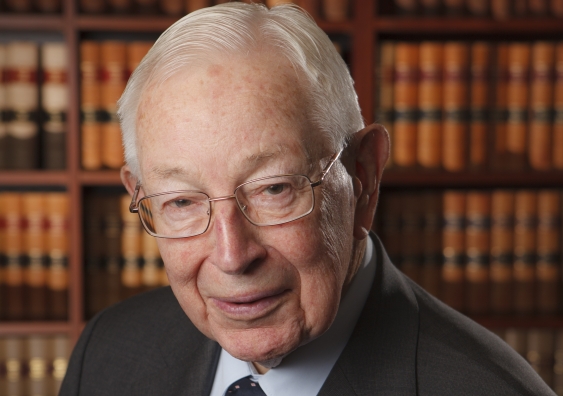
Sir Anthony Mason was Chancellor of UNSW from 1994 to 1999.
Photo: UNSW Sydney

Sir Anthony Mason AC KBE GBM KC has died aged 100, leaving a profound legacy in the law and a long association with UNSW.
UNSW Sydney has paid tribute to the life and achievements of Sir Anthony Mason, the University’s fifth Chancellor and Australia’s ninth Chief Justice of the High Court.
A central architect of modern Australian law, Sir Anthony served on the High Court for 23 years. His influence extended far beyond the bench, through his enduring engagement with legal scholarship, education and public life.
Sir Anthony was Chancellor of UNSW between 1994 and 1999 and the inaugural Chair of the Advisory Committee to the Gilbert + Tobin Centre of Public Law. He remained closely connected to UNSW throughout his life, contributing his time and expertise to students and researchers.
UNSW Vice-Chancellor and President, Professor Attila Brungs, paid tribute to Sir Anthony’s extraordinary contribution to both the University and the legal profession.
“Sir Anthony had an enduring impact on Australia and on UNSW. A lawyer of deep learning and immense wisdom, he also embodied the belief that legal principles should respond to society and shape it for the better,” Prof. Brungs said.
“His leadership was inspiring in the law and as Chancellor of UNSW. His example lives on in the principles and purpose of the University to which he made such a lasting contribution.”

A jurist who shaped Australia
Anthony Mason was born in Sydney in 1925. He became a wartime aviator, flying non-combat missions during the final year of World War II, before studying law. He joined the Sydney Bar at 26, was appointed Commonwealth Solicitor-General at age 39 and was made a Justice of the High Court of Australia in 1972, aged 47.
Sir Anthony was part of a High Court that delivered landmark legal decisions. In 1992, he joined a majority of the Court in recognising an implied freedom of political communication in the Constitution. It placed limits on legislative efforts to restrict freedom of speech, constraints that governments continue to test today.
That same year, under his leadership as Chief Justice, the Court handed down the historic Mabo decision, recognising native title for the first time and overturning the doctrine of terra nullius – meaning ‘nobody’s land’. Its consequences were monumental and continue to shape Australia’s national story.
An enduring impact at UNSW
Dean of Law & Justice at UNSW, Professor Andrew Lynch, said Sir Anthony was a hugely respected figure.
“His generosity to the academic and student community over many years was immense. He was particularly involved in the work of the Gilbert + Tobin Centre of Public Law, as inaugural Chair of the Centre’s Advisory Board and through his participation in many Centre conferences and events,” Prof. Lynch said.
“Sir Anthony also gave his time to deliver guest lectures to undergraduates and to engage deeply with our PhD students. A towering figure in Australian law, we felt very lucky to enjoy a special relationship with Sir Anthony as the law school of UNSW, where he had served as Chancellor.”
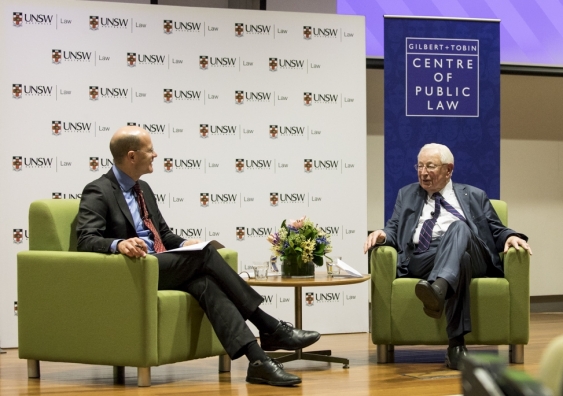
In 2016, UNSW Law & Justice launched The Mason Conversation - a series named in honour of Sir Anthony, marking his outstanding generosity and decades of contribution to the University.
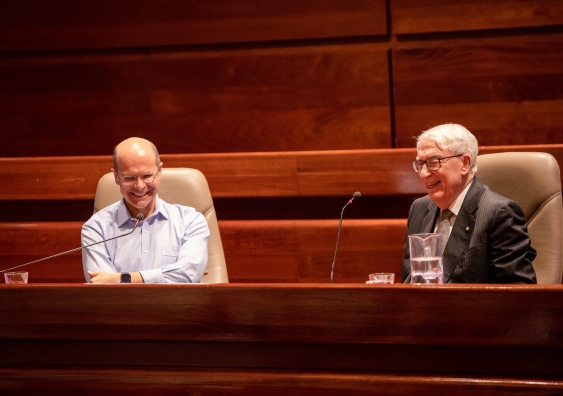
The Inaugural Mason Conversation featured a dialogue between Sir Anthony Mason, former Dean of Law & Justice (2016 - 2020) Professor George Williams AO and a large public audience, including many students.
Sir Anthony discussed future challenges for Australian law and government. He also talked about influences and milestones in his long career as barrister, judge and public figure.
UNSW Law & Justice named an undergraduate essay project in his honour, encouraging students to pursue advanced research in public law. The faculty also established a chair in his memory.
“I feel truly honoured to occupy a chair that bears his name, following on from our distinguished public law colleague, WSU Vice-Chancellor George Williams. I also feel very lucky to have counted him as a longstanding mentor and friend,” said UNSW Anthony Mason Professor and Scientia Professor Rosalind Dixon.
Tributes to a life of legal distinction
Australia’s Attorney-General Michelle Rowland said Sir Anthony Mason was guided by a deep respect for fairness and for the rights of all Australians.
“As a Justice, and later Chief Justice of the High Court, he helped shape modern Australia through some of our nation’s most significant judgments, including presiding over the landmark Mabo decision,” she said.
“He will be remembered for his wisdom and intellect, and his enduring contribution to our legal system, academia and public life.”
NSW Chief Justice Andrew Bell AC also reflected on Sir Anthony’s profound influence on the law and those who worked with him.
“To observe at close quarters this master judicial craftsman at the peak of his powers was an opportunity as rare as it was invaluable,” he said.
“A very fine Australian has left our midst, but his impact and legacy will continue.”
Media enquiries
For enquiries about this story please contact Ashleigh Steele:
Tel: +61421308805
Email: ashleigh.steele@unsw.edu.au